Friday, April 22, 2016

Emma and Julia Love Ballet

Emma and Julia Love Ballet

Written and illustrated by Barbara McClintock

Scholastic Press, 2016, Ages 4-8

This book looks at the lives of a young girl and an young adult girl. They are very similar with their love of ballet. They both have similar daily routines as well. They wake up early, eat breakfast, get ready for ballet lessons, get prepared for practice, stretch and warm up at practice, and love their dance instructors. The only difference is that Emma is a young dancer with aspirations of dancing on stage, and Julia dances on stage as a professional dancer. At the end of the story, Emma ends up getting to watch Julia dance at a show. There she gets to meet Julia and get her autograph. 

 In this book, the author’s writing style is rather simple. During most of the book, the author compares the two main characters in the simplest of ways. She uses the words “too” a lot to emphasize the similarities between Emma and Julia. The author also uses a lot of action verbs throughout this book to demonstrate Emma and Julie’s day-to-day lifestyles. The author’s writing style is very appropriate for the age group which this book is aimed to entertain. 

The illustrations in this book are very colorful, and they represent diversity with the different skin tones used on the different characters. There are many different settings illustrated in this book. Those include the girls’ rooms, kitchens, dance studios, and lastly, the recital place in the city. Throughout the book, there are numerous illustrations that represent action and movement within the two girls and their dance peers. 

I really enjoyed this book and its beautiful illustrations. I love to dance myself so I was interested in this book as soon as I saw the two ballerinas on the cover. I liked the life comparisons it made between these two girls who have a rather large age gap. The end was also very cute whenever the little girl got to meet the older girl, who happens to be her idol. This book portrays determination, perseverance, and dreams. Those are all really awesome aspects to bring up in a children’s book, and I would recommend it to any young child (ages 4-8) who takes an interest in ballet or dance in general. 

Reviewed by Ciara Gable

Behold! A Baby

Behold! A Baby

Written by Stephanie Watson; Illustrated by Joy Ang

Bloomsbury Children's Book, 2015, Ages 5-8

The book Behold! A Baby, is about a father performing an act (like a magic show) who talks about his baby and all the amazing and astounding actions or activities that the baby can do. While the father is talking about the baby, his other son states, “what is the big deal” as well as “I can do that.” The little boy plays a part in the show by acting like he wasn’t impressed, but later into the story you find out that it was just for show and that he actually loves his baby brother. The older brother likes the idea that he will eventually get to teach him all the things he knows how to do. 

The author's writing style is exciting, expressive, and bold. If you were to imagine yourself at a magic show, the magician would be trying to get the audience excited about the tricks. The author makes it expressive by having the older brother playing along with the act and how he is not impressed with the tricks that the littler baby is performing. When in reality, the baby is not doing anything special. Over all, the author’s writing style is fun and enjoyable for children. 

I love the illustrations in this book. There is an illustration on every page, which helps the read understand what’s going on within the story line. On the pages that the father is explaining what the little baby will do next, the page is colorful and bold. While on the page where the older boy is not impressive, it is a lot of white space in the background and the boy is in color. This helps to show readers what is the most important to concentrate on in the book. The use of dark and light colors are very helpful for the illustrations because when you are the performer the light shades are used. On the other hand, when you are watching the performance, the audience is illustrated by being the dark shades. This causes an illusion and play on the eyes for someone to focus their attention where the bright lights are, not the darker colors. 

 I thought this book was very creative. The author used her knowledge of magic shows and transformed it into a book about two brothers and their father. The text and illustrations play hand and hand by allowing the reader to understand the story as a whole. I think that this book would be great for children to read. It’s funny and entertaining, as well for the reader has a sibling of the same age. 

Reviewed by Stephanie Shaw

Thursday, April 21, 2016

A Fine Dessert: Four Centuries, Four Families, One Delicious Treat

A Fine Dessert: Four Centuries, Four Families, One Delicious Treat

Written by Emily Jenkins; Illustrated by Sophie Blackall

Schwartz & Wade Books, 2015, Ages 4-8

Fiction, with a little bit of history tied within, this story is about four different families from different centuries that make the same tasty dessert: Blackberry Fool. The first family was from the 18th century and they lived in an English town. To get the ingredients to make the recipe, they picked berries from the bushes and milked the cow to turn the milk into cream. To keep it cold until dinner, they stored it by sheets of ice in a hillside, since they did not have a refrigerator. The second family was from the 19th century and they lived on a plantation farm in the south. They also picked the berries from the bushes, but they got their cream from a dairy. They stuck the dessert down in the basement to keep it cold. The third family was from the 20th century and they lived in Boston. They got their fresh berries from a market and cream from their everyday delivery. To keep it cold, they put it in a wooden icebox until dinner. The last family was from the 21st century and they lived in San Diego. They purchased their blackberries and cream from the supermarket. To keep it cold for the party, they stuck it in the refrigerator. 

The author’s writing style is repetitive because she keeps telling how each family obtains their ingredients, how they make the dessert, and where they put the final product for it to stay cold until dinner. For example, “They carried the mixture to an ice pit in the hillside. It chilled near sheets of winter ice, packed with reeds and straw. They carried the blackberry fool to a wooden icebox stocked with blocks of ice they had delivered each day.” Emily Jenkins’ writing style is simple, but very thorough in explaining how each century is different. As time progresses, new technology is invented, so different tools are used to make the recipe. 

The illustrator used different colored pencils to represent the images for this book. Before she even began creating the pictures, she did extensive research on what each image should look like since it was coming from a different time period. The most effective illustration that develops the story as a whole is the girl and her mother picking the berries in the 19th century. It shows that they are a different race, but it makes the story more unique because it brings up the different cultures. To make the story more whole, the illustrator was able to capture a family from the 19th century and how they prepped and made the dessert. 

I loved the book. I think the book met its goal on trying to capture a recipe made from four different time frames and their families. Parents and children will both enjoy this book too because not only is it about dessert, but it also teaches a lesson on what one has to do when getting ready to make something. I liked how the author included each step on how each family made it. The event of making the delicious dessert is most certainly something children will understand and probably even want to make since the recipe is included in the back of the book. I liked how both the author and illustrator were able to capture each century and how things changed, either dealing with technology or where the ingredients came from. For example, “When they got home, the man printed out a recipe from the Internet. The boy beat the cream with an electric mixer.” This quote explains how during the 21st century, in order to get the recipe, it needed to be printed off of the internet. As well as showing how the boy used an electric mixer, possibly showing the difference in centuries and how electricity is more involved and common around households. 

Reviewed by Beth Helms

Funny Bones: Posada and His Day of the Dead Calaveras

Funny Bones: Posada and His Day of the Dead Calaveras

Written and illustrated by Duncan Tonatiuh

Abrams Books for Young Readers, 2015, Grades 1-5

The story is a biography about José Guadalupe Posada and his famous artworks called Calaveras. The story explains what a calavera is and how to pronounce it. It also explains how Posada developed his passion for printing. The story fully explains what lithography is and how Posada used it to create his artwork. The story also explained his adult life, his marriage and children and disasters that struck his homes. The story fully explains what Dia de Muertos is and how Posada’s Calaveras were used for this very important Mexican holiday. The story explained how he became more famous after his death for his artwork. The story also takes a guess at what Posada’s Calaveras may look like if he were to create them today. After the story, the author explains extensively what El Dia de Muertos is and how it became a holiday and how it is celebrated. There is also a glossary at the end to help children who read this book fully understand what is being discussed in the book. 

The author’s writing style is obviously for children. He uses straight forward writing with simple explanations on what he is writing about. The author does a great job of making the story engaging for children and explaining Posada’s life. He fully explains the techniques that Posada used when creating his artwork and why he chose to use these techniques. The author also adds questions for the children who are reading the story to think about, creating an extension to the book. 

The illustrations in the book are very colorful and take up the entire page. When the book is talking about lithography, engraving, and etching there are pictures that help the text explain each step involved in these techniques. The illustrations are very engaging and support the text on the page as well as the story. The author/illustrator also included some of Posada’s actual artwork throughout the book, in the illustrations that go with text and as full page examples of the artwork. 

I absolutely loved this book and highly recommend it to be used in a classroom for Day of the Dead discussions and lessons. The story is very engaging and the illustrations and examples of artwork makes the story very engaging. The glossary at the end, as well as the engaging questions throughout the book, makes the learning experience enjoyable for people of all ages. 

Reviewed by Stephanie Wonnell

Pete the Cat and the Bedtime Blues

Pete the Cat and the Bedtime Blues

Written by Kimberly & James Dean; illustrated by James Dean

Harper Collins, 2015, Ages 3-7

Pete the cat and his friends, Gus, Alligator, and Toad are having such a groovy time at the beach surfing and turfing. All of a sudden, the sun starts to go down and Pete thinks about what they will do now? Then, he gets a great idea to have a sleepover at his house, so the fun can continue. Pete, Gus, Alligator, and Toad have a party in Pete's room until Pete decides it is time for bed. But what happens when Pete's friends don't want to go to bed? They just want to stay up instead. After hearing clap, rat-a-tat, and munch Pete gets hit with the bedtime blues. 

The writing style of this book is very creative and silly. Onomatopoeia is used throughout the story, which adds some humor to the story. For example, Pete hears "Munch, munch, munch" and the word itself sounds just like it's spelled. So at this point in the story, the reader can hear the sound of someone eating in their mind. Rhyme is another literary element that makes this book so enjoyable for a young audience. Words such as head, bed, hunch, and munch are all example of rhyme. The rhyme helps the words dance across the page and the story flow, leaving not one dull moment. Overall, the style of writing of this book is clearly aimed at a younger audience and to set the tone. 


The illustrations show a variety of shapes and colors. The pictures show Pete the cat and his friends in their pajamas having so much fun. The dark blues really help create a calming and soothing mood since Pete and his friends are getting ready for bedtime. In contrast, the bright colors such as red, yellow, and orange help get the reader excited and really feel that excitement any child would feel from playing in the sun at the beach. The illustrations definitely extend the text and add to the overall joy of the literary piece. 

I would recommend childcare providers, parents, teachers, and nurses to get this for the children they take care of. A child who is sick and on bed rest could benefit a lot emotionally and socially from having a nurse read this story to them. Its sense of humor would light up the child's mood and take their mind off of being in the hospital. This story is great to have on the shelf at home and in the classroom for group story time. It reminds children of when they have to go to bed and don't want to. This is a great book for preschool and early school age children. 


Reviewed by Naomi Sade LaVette 

Hippos Are Huge!


Hippos Are Huge!

Written by Johnathon London; Illustrated by Matthew Trueman


Candlewick Press, 2015, Ages 5-8


Johnathan London wrote Hippos Are Huge as a book for entertainment and to inform readers about Hippos would be considered a non-fiction book because it contains facts about the characteristics of Hippos and explains the life of a Hippo. The author does not just state the facts throughout the book, but kind of tells a story of a female Hippo named “Hippo”. It tells how Hippo will mate in the dry season and her baby will be born in the wet season. Hippo is shown swimming in the water and how she will sit and rest while cattle egret eats bugs out of her ears and fish eat the food stuck between her teeth. The reader gets to see two sides of Hippos. They see how dangerous Hippos are with their large mouth and tusks, and that the females are quite nurturing with the babies. 

This book is written in an informational way, and it includes some elements that stand out to a reader. The author used bold text for some of the adjectives used to describe hippos. For example, “Hippos are HUGE!”. The word “huge” is in bold, larger than the rest of the text and all the letters are capitalized to add emphasis. This book also contains onomatopoeia to make the text enjoyable. When two bulls start to fight and are using their tails to swat balls of poop at each other, the author puts in “Splat” and “Splop” to give affect to the fight. This makes the reader feel like he or she can hear the hippos swatting at each other. Throughout the book the author uses adjectives and onomatopoeia to enhance the readers experience. 
    
Since this book is a picture book, an important element is the illustrations. The illustrations in this book are created with the use of watercolor paints. All the different colors of the hippos, sky and the water mix into each other that gives the illustration a more realistic touch, it is more realistic because there are imperfections. A hippo is not just one color, so the use of water color blends in the pink, purple and grey together. The illustrations develop the text by showing motion underwater and dung being flung from one page to another. The most influential illustration for me would be the page were Hippo is relaxing in the water with only her eyes, ears and nose sticking out of the water. Right under that illustration Hippo is getting her ears cleaned by a cattle egret and her teeth cleaned fish. This shows that hippos are not aggressive with all other animals because they allow others to use them for food. The illustrations in Hippos Are Huge, helps the reader visualize what is going on in the text and further enhances learning. 
    
Overall, I think this book is an excellent source for educational purposes, but would not be something I would read just for enjoyment. It really depends on the reader. If the reader is really interested in animals, this book would be amazing because it covers all kinds of information about hippos and their life styles. Also, it is full of facts that most people would not know about hippos, for example they are the most dangerous animal in Africa. The story line to the book is not exactly noticeable in the beginning of the book, but eventually starts into telling about the life of a female cow named Hippo.


Reviewed by Rachel Osterloh 

Wednesday, April 20, 2016

You Make Me Happy

Tuesday, April 19, 2016

Ketzel, the Cat Who Composed

 Ketzel, the Cat Who Composed

Written by Leslea Newman; illustrated by Amy June Bates

Candlewick Press, 2015, Ages 5-10

 The first page starts off the story as the author talks about a man in his apartment building playing his piano. The story then goes on to tell how the man had been playing piano for a very long time. He plays every day and then goes for an afternoon stroll. One day he is walking and finds a lonely kitten who he names, Ketzel. He takes the cat home and together they start to make beautiful music. He ends up entering a contest and he doesn’t win but everyone loves the piece created by him and Ketzel. The author shows a couple of themes, which included happiness, success, friendship, and love for music and animals. 

The author's writing style is a bit advanced for most readers. He uses words over and over again. Such as on page two, he says: “Moshe was a composer. Every morning he composed himself by sitting very still. He listened outside himself and listened inside himself”. I think that parts of those couple of lines young readers may have to think about, or even ask about because they might not understand the depth of what it truly means. A good way the writer writes is how he says what each character is thinking and doing. I think it’s good to show the cat’s personality as well as Moshe the composer. Overall his writing is clear, and well thought out. 

The illustrations are just simply beautiful. The pages are created by watercolor, and gouache. From the first page the colors are calming. The background tends to be gray and not as important as the front colors are bright. The front colors also tend to be ones that have focus on them. The building where the composer is stands out the most because of the red tones. Overall, each page was well thought out. The details are amazing and show what the author is trying to get across. Each image fades in with the rest of the pictures makes each image welcoming and quaint. 

Overall, I would rate the book a seven out of ten. I would recommend this book to others.The text at times might be a bit confusing for a young child to understand but it also allows for the child to grow as a reader. The pictures are really inviting to a child at any age. The story line is one that has the reader saying “how cute”. The image of the kitten alone is why the child will want to pick this book up over and over again. For children with a love of music or animals they will want to pick up this book, and have mom and dad read it over and over. The book deserved the Sydney Taylor winner, and I’m ready to keep any eye out for other books Newman writes. 

Reviewed by Bailey H

Mixed Me!

Mixed Me!

Written by Taye Diggs; illustrated by Shane W. Evans

Feiwel and Friends, 2015, Grades 2-5

This story is about a young boy named Mike who is mixed. His mother is white and his father is black, and he is often judged because of this fact. His friends call him Mixed-up Mike because they have noticed that his parents “don’t match” (Diggs 11), and they are confused. They point out his differences, making fun of his hair, as it is a “zigzag curly ‘do” (4), but Mike pays no attention to their words. He is confident in himself. He likes himself just the way he is, and he is proud of his identity. Through the course of the story, he expresses the belief that race doesn’t matter, encouraging readers to be more open-minded and accepting of others, as he has so expertly demonstrated. 

 The author writes this story in a very unique way. The book begins with the phrase, “Hey, now!” (1), indicating that the speaker, Mike, is going to present an argument to his readers. This is proven to be the case, as he goes on to refute the judgements that so many people have placed on him as a mixed child. Additionally, the author uses informal diction or “slang,” and multiple instances of rhyme in the text to increase the pleasure that readers feel when reading it. He has presented a serious topic in an enjoyable format, ensuring that readers have fun reading the book. 

The illustrations add a level of complexity to the text of the story. For starters, the illustrations are done in a manner that highlights the mixing of colors, depicting this in a positive light, as Mike is seen wearing a cape of many colors, carrying a multicolored skateboard, and wearing shoes of different colors. In addition to this, in the backgrounds of many of the pictures, readers are able to see pictures of the family demonstrating their love for one another, indicating that regardless of a difference in race, they are full of love for one another. The pictures are able to show that in reality, love transcends the racial boundaries that society so often places on people. Furthermore, the word “mix” and many of its derivatives, such as “blended,” “fused,” “united,” and “merged” (17-18), are incorporated into the illustrations to emphasize the story’s theme of acceptance and inclusion. 

Upon reading this book, I immediately loved it. It explores the topic of race, a subject that is generally regarded to be “heavy,” in a way that children can understand and relate to. The author encourages readers to rid themselves of their judgements, and instead, be more accepting of others and the things in which they do not understand. At the same time, he encourages mixed children, and children who are deemed “different,” to take pride in who they are. For these reasons, I would absolutely recommend that elementary school teachers use this book in their classrooms. 

Reviewed by Taylor Newcomb


A Lucky Author Has a Dog

A Lucky Author Has a Dog

Written by Mary Lyn Ray; illustrated by Steven Henry

Arthur A. Levine Books, 2015, Grades-Kindergarten to 2nd

This book is a picture book that goes through the story of an author and her loyal dog. It begins with an author waking up and going through the daily process of trying to write a story. The book explains that authors write in all different locations like offices, outside, even in bed. The dog watches his author try to write, even though sometimes it is hard for her to come up with a story. The author even goes into a school and talks about her work with a group of students. The book also describes how authors can get inspiration from anything, and sometimes it may take a while to find what they want to write about. Throughout the whole story, the loyal dog stays by the author’s side and helps her along. 

Mary Lyn Ray is the author of this book, and she has a great style of writing that engages the audience. The book is a fiction book, with fictional characters, but the story line of the book is based on true events of how authors work. The fiction aspect of the author is intriguing, but the dog is also a huge part of the book. The style of writing also has some dialogue throughout the text, which also works to engage the audience. Children listening to this story being read to them may have some of the same questions that the class in the book have. This can help children to feel connected to the story. There are also no names given to the characters in this story, they are simply referred to as author and dog. I think that this is another way for children to feel connected to the story, because they can look at themselves as the characters. Overall, I think that Mary Lyn Ray’s writing style in the book really engages children reading this book. 

The illustrations in this book are very detailed. There is an illustration on each page, all filled with color. From the steps of the apartment to the fur of the dog, there is so much detail on each page. One big thing I noticed with the illustrations is that each one shows a very realistic scene. They illustrate real life activities like moving homes, going on a walk, and waking up. Children especially will enjoy these pictures because they can picture themselves in the same situations. The illustrations also add life to the text of the book. For example, the illustration of the author and the dog going on a walk truly seems to jump off the page. 

After reading this book, I think that it is a wonderful book to read with students and I would recommend it to others. The book is about an author, which I think opens great discussions for students. It talks about the process of how an author writes, and this is important for students to learn. It also shows that sometimes an author might not be able to write their story the first time they try, it may take a while. This is an important lesson for children to learn. Students listening to the book will better understand that they should keep trying if they do not succeed right away. The character of the dog is also familiar to many students, so it is entertaining to them. Many children have a dog, or know someone with a dog, so they can picture their own dog in the story. This is a great book for young children to learn about the process of writing. I also like that it looks at some of the challenges of writing like the fact that sometimes it may take time to put thoughts into words. Being an author is not an easy task, but with a loyal friend like the dog in the story, it can be a little bit easier. 

Reviewed by Maggie Ernstes

A Hole in the Wall

A Hole in the Wall 

Written and illustrated by Hans Wilhelm

Holiday House, 2016, Ages 4-7

The story is about four animals and a hole in the wall. The dog found a hole in the wall, so he looked in the hole and saw another dog. The dog then went back and told his friends the lion, elephant, and warthog that he found a hole in the wall and there is another dog inside. After this the lion, elephant, and warthog each went and visited the whole, by themselves, and they each came back and said that the animal who looked in the whole before them was wrong because each of them saw that same animal that they are in the hole. This made all of the animals mad so they went and looked in the hole together, and this time they saw each of them in the hole, and this made them happy because then everyone was right! However, at the end it explains that the hole in the wall wasn’t actually a hole, and the picture shows that it is a mirror. 

The author's writing style is very short and simple, but it goes along with what he is trying to teach his readers. The author uses colors to match the animal words to the color of the animals, so when a child is reading this they can see that a warthog is pink. The author also uses repetition through out the entire book. Since the author uses repetition this will help his readers learn how to say elephant, and maybe they will even be able to recognize the word elephant by the end of the book. Overall, the authors writing style will help his readers learn and be able to recognize simple words and the words for certain animals. 

The illustrations really help the readers understand what exactly a lion, elephant, dog, and warthog look like. This is good, especially for young readers, because they will be able to connect the word with the picture of the animal. The illustrations also show the readers that each time the animal is going to the hole they are seeing something that looks exactly like them, and the animal in the hole is doing exactly what the animal outside of the hole is doing. Meaning that the illustrations are giving a hint to the readers that maybe this isn’t a hole in the wall. The illustrations also do a good job in showing when the animals were mad for being told that they were wrong, and then at the end when the animals were happy because they were all right about the hole. 

Overall, I liked this book, and I defiantly recommend it for others, especially young children and teachers. I liked this book because it is a good book to read to younger students to get them to recognize certain words, colors, and animals. Having said this, I would defiantly read this book to my future students if they were in pre-school or maybe at the beginning of Kindergarten. The book is also a good book because it is simple enough that a child who is just starting to read on their own could try and read this book, and if they needed help while reading the pictures go along with the text well enough that they could use the pictures to help figure out the words. 

Reviewed by Christine Stemen


Pipsie, Nature Detective: The Disappearing Caterpillar

Pipsie, Nature Detective: The Disappearing Caterpillar 

Written by Rick DeDenato; illustrated by Tracy Bishop

Two Lions, 2015, Ages 5-8

Pipsie is a young girl with a pet turtle named Alfred. One morning, Pipsie found a caterpillar on Alfred’s head. The caterpillar’s name was Frannie and the three of them immediately became friends. One day, Frannie was nowhere to be found. Pipsie and Alfred looked everywhere for her so they put on their detective gear and began to hunt for clues. They found a chewed up leaf in the backyard and took it to zoo to find answers. At the insect garden at the zoo, Pipsie and Alfred learned lots about caterpillars like Frannie and even saw a chrysalis. One of the zoo guides helped the two friends and told them to look for one at home and that’s where Frannie will be. After Pipsie and Alfred found the chrysalis, they waited 10 days before Frannie the caterpillar became Frannie the monarch butterfly and the mystery case was finally solved. 

DeDonato offers a cute, animated writing style throughout the book. He sometimes puts full words in capital letters to put emphasis on something. For example, Pipsie once says, “Alfred, I think you’re turning into a TIGER.” He also includes a lot of academic content into the story such as the amount of time a caterpillar in in the chrysalis to turn into a butterfly or what kind of plant caterpillars like. 

I love Tracy Bishop’s illustrations. They’re cute and soft like nature is. She adds human like characteristics to the turtle and caterpillar as the turtle wears a hat on his head and the caterpillar wears a bow. I feel that this models how humans and animals/insects are more similar than different and should be treated with care. The illustrations are beautiful and play a large visual role in understanding some of the academic content within this book. 

This was a great book. I would share this book with students to introduce caterpillars and butterflies in a science unit. This book is also great to inspire children to be nature detectives themselves and explore the world around them. I would recommend this book for five to eight- year-olds to get these youths to observe their environment and the nature outside their door. 

Reviewed by Hannah Heifner

Life Without Nico

Life Without Nico

Written by Andrea Maturano; illustrated by Francisco Javier Olea

Kids Can Press, 2016, Ages 4-8

This story is about two best friends who do everything together. One day the boy's dad tells them that they are moving away. The kids get really upset and the girl has to learn to live without her best friend Nico. As the story continues she discovers new things in life that make her happier even if Nico isn't there. By the end of the book Nico moves back and the girl wonders if he will be able to fit into her new life. When he comes back she realizes that "there are some things that cannot change". 

  The author's writing style is simple, but gets the point of the story across at the same time. She does a good job at describing what each character is going through, while at the same time keeping it sweet and simple. 

The illustrations are impeccable and really pull the reader in because they accurately portray what each character is feeling throughout the entire book. They are so intricate and unique in their own way, but at the same time they look almost effortless. He does a great job with shading and catching the mood of what is being told with his illustrations. 

I would recommend this book to any teachers who are looking for books to read for their young students. It has a great message and children Pre-K through third could definitely benefit and enjoy this book. 

Reviewed by Hanna Weber

Wednesday, April 13, 2016

I Hear a Pickle (and Smell, See, Touch, and Taste It, Too!)

 I Hear a Pickle (and Smell, See, Touch, and Taste It, Too!) 

Written and illustrated by Rachel Isadora

Nancy Paulsen Books, 2016, Ages 2-5

This story introduces the five senses to young children. Each section focuses on one of the senses, using text and pictures to describe activities in which each sense is used. The activities range from hearing ocean sounds to tasting different foods. The activities reflect familiar experiences many children have already had or will have in the future. The ending ties the entire book and all five senses together by describing a pickle based on what you taste, smell, see, touch, and hear. 

Isadora’s writing style appeals to a young audience because of her use of humor. She uses phrases about silly noises and gross smells that would make any child giggle as they read or listen to the story. She also uses a lot of onomatopoeia, especially when talking about the sense of hearing. Animal sounds and noises we make as we eat different foods are just a few of the sounds she includes in her writing. Her writing is also very descriptive, as she describes in great detail how our senses are stimulated in each experience. The humor and descriptiveness is successful in creating an enjoyable reading experience while also teaching readers about the five senses. 

The illustrations in this book are a major part of the story. Each experience that the author describes is accompanied by an image depicting it, which appeals to the reader and adds to the understanding of the sense that is being used. The people in Isadora’s illustrations are extremely diverse. They are all different genders, ages, races, and wearing different types of clothing. This exposes children to a diverse population that they can relate to in different ways. With multiple illustrations on every page, it is essential to the story and enhances the text for children. 

 I think this picture book is fantastic for young children. The author uses humor, onomatopoeia, descriptive words, and illustrations to enhance the story and make it enjoyable for early readers. It also promotes some understanding of the five senses and relates it to experiences children have in their daily lives. This could easily become a favorite book for young readers because the short phrases are fun to read and easy to remember. 

Reviewed by Hayley Lepkowski

Jessica's Box

Jessica's Box

Written and illustrated by Peter Carnavas

Kane Miller, 2015, Ages 6-8

This fiction book is a story about a young girl, Jessica, who is about to start at a new school. She is nervous about fitting in and making new friends. So Jessica has this idea that she should bring a box to her new school to intrigue her new classmates. First day she brings a stuffed bear, the next day cupcakes, another day is her dog. All these attempts seem to fail with her classmates. Jessica is frustrated and lonely so she puts her head in the empty box. The next thing you know a little boy sees Jessica with her head in the box and the little boy wants to play hide and seek with her. Jessica finally found her first friend. 

The author is writing most of the book in dialogue between Jessica and her family or her classmates. The book is also written in third person language and tells what Jessica's feelings and emotions are. The author uses words that can be understood by the audience. 

The illustrations in the book appear to be watercolor with black for the outlining and to show more depth and detail. The pictures throughout the book show what is happening with the text and show Jessica's feelings. 

This book was a very simple book but with a powerful message. I believe it would be good in first or second grade classrooms when a new student is about to be introduced. This book would be helpful for this situation because you get to see the perspective of the new student. It also shows what Jessica's classmates did wrong in this situation. 

Reviewed by AK

Happy in Our Skin

Happy in Our Skin

Written by Fran Manushkin; illustrated by Lauren Tobia

Candlewick Press, 2015, Grades PK-1

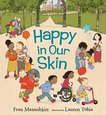
This book talks about everyone’s differences. Their skin color, hair color, birthmarks/freckles vary from person to person. It shows that it’s okay to be different from other people. Everyone is different, and that’s what makes you, you. She makes children look at other people’s differences and accept them. No person is the same. It doesn’t matter if someone is a different color than you, they are still a person; they just look different. They are who they are, and you are who you are which makes everyone unique. 

The author writing style is simple enough for younger children, even though there are a few harder words. A child could sit down and read the book with very little help. The author uses onomatopoeia in the book. It makes the text more interesting for the reader. Fran Manushkin also uses rhyme throughout the book. She uses an ABAB form. Sometimes both A and B rhyme and other times only one of them rhyme. It varies throughout the book. The rhyme scheme makes the book flow and easy to read. Another element that is in Manushkin’s text is descriptive words. She makes the words come to life with the amount of descriptive adjectives. For example, she says, “cocoa brown, cinnamon, and honey gold” to describe the different skin colors, and “Ginger-colored babies, peaches and cream, too” when describing hair color. This makes the reader compare skin and hair color to something dealing with food and spices instead of just saying color. This makes the book much more captivating and fun to read. The reader enjoys getting these types of mental pictures and comparing them to what she is talking about. The author does a very nice job of this. 

The illustrations enhance the words by giving the audience a visual to the beautiful text. Each picture shows something different and adds to the story. They show all the differences that the author’s words tell the audience. People of all sizes and colors and all the different cultural backgrounds are illustrated in the book. They are all drawn together, interacting with each other. It shows the audience that even though everyone is different, we all can accept each other and our differences and be happy. Being comfortable in your own skin is important and depicted in the book. The illustrations also show children in wheelchairs, glasses and from different cultures. This shows the reader many more differences that can be around them. We all come from a different background and that is okay. In the illustrations, all the people look happy. This makes children think about acceptance and not judging others just because they are different. 

I would recommend Happy in Our Skin to other people. This book is a very good and easy read for young children. There are a few hard words in it, but overall it’s suitable for younger children in kindergarten or first grade and anyone who enjoys a good picture book. The words are captivating and the pictures draw the audience in. It shows the reader that being different makes you who you are and the importance of acceptance. Throughout the book, the illustrations focus on people accepting one another for who they are. This gives the message to the reader that you are different and so is everyone around you. Since we are all different, why not accept those differences and not judge others based on those differences. 

Reviewed by Carley Straley

You're a Crab!: A Moody Day Book

You're a Crab!: A Moody Day Book

Written and illustrated by Jenny Whitehead

Henry Holt and Company, 2015, Ages 3-6

This story is about different moods that a person can have throughout the day. Each mood is related to a specific sea animal. For example, the sea turtles are frustrated. This book also tells you things you can do when you are in the specific moods. For example, it tells you when you are upset it is fine to go sit by yourself until your mood changes. It almost has every mood that children this age would go through in their life. 

Jenny Whitehead writing style is perfect for children. She uses descriptive writing to explain to the children that having different moods is a normal thing. She also has some Onomatopoeia in her book while talking about what each animal does. Some examples are “Chomp”, and “Zaps”. These will help the children know more about what the animals are doing which will tell the story better. She also has the main story at the side of the page and then adds more text in the pictures. These added words in word bubbles and signs add more to the story. All of the text is also appropriate for this age group. All of the ideas being told are all said in a way that children will understand. 

The illustrations in this book are very good. They help to tell the story and add more to it. They are all animated sea animal characters. The details in their faces help to show their moods, which is extremely important because that is what this book is all about. The backgrounds also help the reader by showing where those animals live. I also like how they add funny things to some of the pictures like a man with a treasure chest in the whale’s mouth to make the pictures more entertaining for the reader. 

I think that this is a perfect book for children. This is because of both the pictures and the text. The theme of the book is every mood is fine to have and this is perfect for children of this reading level. They will be having all different kinds of emotions throughout their lives so this book will be able to help them deal with them. Teaching these important life skills through a book is a great idea. I believe that this is a wonderful picture book because it is both entertaining for the children and it also promotes an understanding for them. I would definitely use this book in my future classroom with my students because it would be relevant for all preschoolers and kindergartners.

Reviewed by Megan 


One Family

One Family

Written by George Shannon; Illustrated by Blanca Gomez

Frances Foster Books, 2015, Ages K-2


This story does not specifically have a plot but rather numerous scenes piled together. Although they are good scenes and well done, they are not essential to the order of the story. The only reason they become necessary is because they count up from the number one to the number ten. The story basically goes page-by-page showing how the number one can actually represent numbers of more than one. For instance, this is shown as one pair of shoes, which is really two separate shoes but united they are one. These findings of things that can represent more than one, but referred to one is constantly relating back to the idea that a family is one. A family is one whole regardless of family size or make up. This is the basis of the book as it counts from 1-10 in order and ends each page with “a family is one.” 

I would describe the writer's style as simple and to the point. The author does not focus on developing the text or plot, but rather focuses solely on showing that the number one can represent different things counting to more than one. In addition, she is consistently trying to bring up the fact that a family is one whole. The author does not use a variety of literary devices and chooses a more simplistic vocabulary. The author is not very descriptive in her writing, but rather more straight forward and to the point. There are only a total of three short sentences per page and they are not long sentences showing that the author is quick in her style. With this being said, it does not mean it is a bad thing, but rather the author focuses solely on theme and the underlying message and neglects the other aspects of literature. 

The illustrations in this book are wonderful. They are complex and creative. They show real families and the differences within each family in a very positive light. The illustrations are bright and positive and use colors that make the pages come to life. The scenes that have been done are realistic and demonstrate the concepts and values of life today. The people within the book are all cheery and happy and show children a sense of happiness in terms of families and people in the world in general. The nature within the book looks crisp and pure and is shown in a simple, yet beautiful way. The illustrations in the book definitely complement the text and I think truly speaks for the lack of text that has been made in this book. The illustrations make up for the fact that things are not directly being explained and readers can visually interpret the author's theme and underlying message through these engaging illustrations. 

In my opinion, this book is great for many reasons. First, because it is a counting book and can help young children learn to count from one to ten in a fun and engaging way. Second, because I like how the author made a point to show that the number one does not actually always mean there is only one object but rather that a collection of things can make up one whole. Third, this was a great concept and it became an even greater concept when the author related it back to families. This showed readers that a family could be less than two but more than nine. It showed readers that families come in all shapes and sizes and have differences in who makes up the family. This is a very important concept especially in today’s society with the staggering amounts of more and more diverse families living on the planet. Fourth, I enjoyed this book because the text was simple and easy for young readers. Lastly, I think this book has awesome illustrations that complement the text and show the world in a bright and positive manner. Overall, I found this to be an awesome read for young learners and one I may perhaps even use in my classroom one day particularly if I have a younger age classroom. 
    

Review by Madeline Pugh